


I have six children. The oldest is fourteen, the youngest is six. Same house, same parents, same books on the same shelves, same dinner table conversations.
They could not be more different from one another.
One of them can find anything — keys, a missing shoe, the thing I put down twenty minutes ago and have no memory of. One can hear a song once and play it back. One cannot keep track of a water bottle for a single school day but will take apart a weak argument in about four seconds flat.
I didn't teach them any of that. I couldn't have. And after fourteen years of watching it happen in my own kitchen, I find it strange that we still talk about children's futures as though the only things that matter are grades and interests.
Four things we keep calling by the same name
Most conversations about careers collapse four separate things into the word "strengths," and the confusion does real damage.
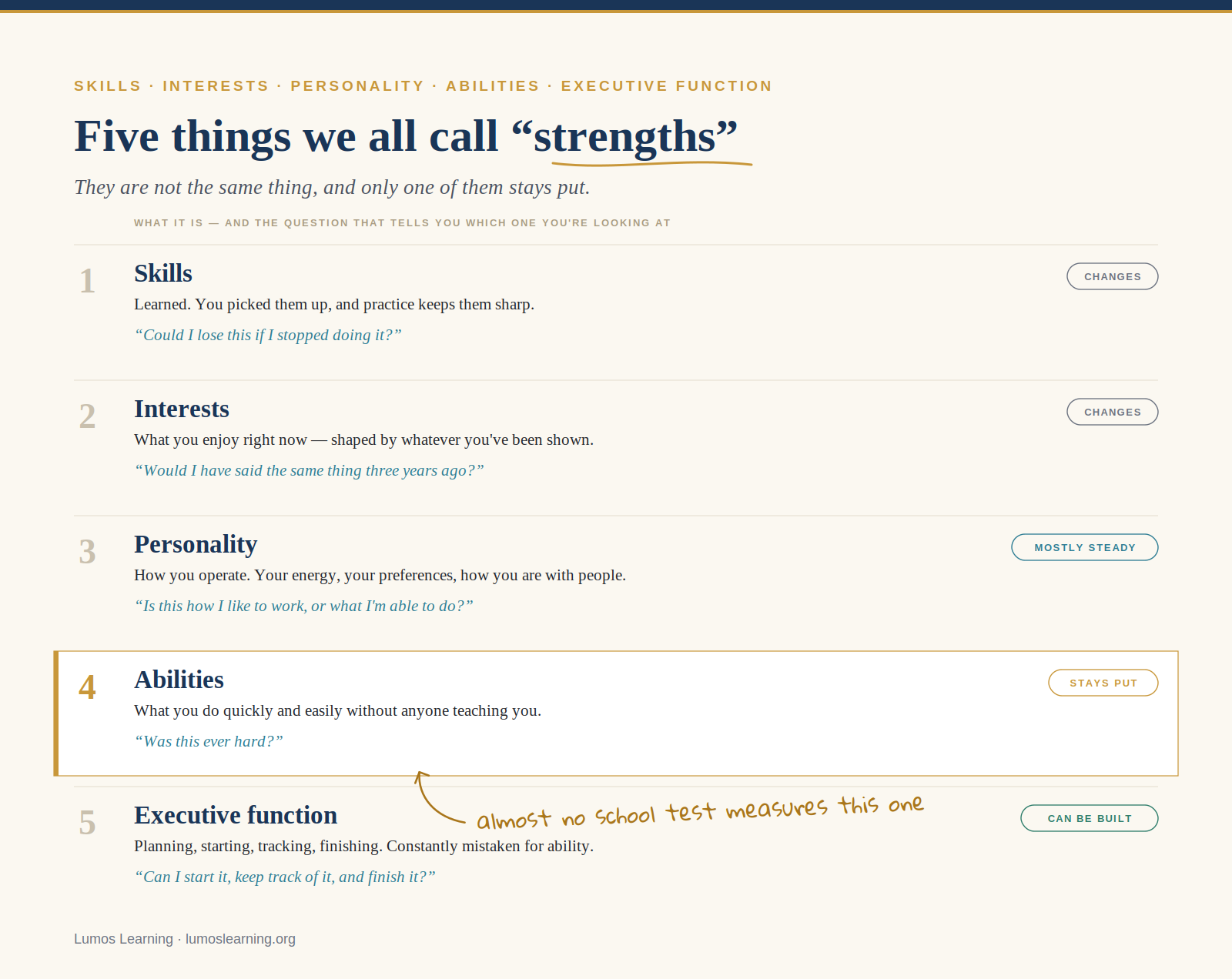
Skills are learned. You picked them up, you can get better at them, and you'll lose them if you stop. Coding, a new language, spreadsheet modeling.
Interests are what you like right now. They shift, sometimes a lot, and they're shaped almost entirely by what you've been exposed to. No child is interested in a career they've never seen.
Personality is how you operate. Your preferences, your energy, how you are with other people.
Abilities are none of those. They're the things you do quickly and easily without anyone teaching you. They settle in the mid-teens and then they stay put. You can build skills on top of them. You can't go get more of them.
Almost every career test a student meets at school measures the first three. Hardly any measure the fourth, which is odd, given it's the only one that doesn't move.
I'll add a fifth, because I spend a lot of my week on it: executive function — planning, starting, tracking, finishing. That's separate again, and it's the one people most often mistake for ability. A student with real strengths and no systems looks, from the outside, like a student with no strengths. I've coached a lot of high schoolers who were quietly convinced of the second thing when the first was true.
Why asking people about themselves doesn't work
Most of the well-known assessments are self-reports. You describe yourself, and the instrument organizes your answers into a profile. That's useful. It's also structurally limited, because you can't report an ability you've never noticed you have.
Nobody says "I have unusually strong visual memory." They say "I don't know why, but I always remember where things are on a page." Same fact. Only one version of it fits in a questionnaire.
There's a floor problem too, and this is the one I care most about. A student who's struggled for years has an account of themselves built out of that struggle, and it's usually much worse than the truth. Ask a fifteen-year-old with ADHD what he's good at and you'll get an answer shaped by six years of report cards and a word — lazy — that somebody used in front of him once and he never put down.
I've sat with a lot of those families. The parents are exhausted, the kid has stopped trying in front of anyone who might be watching, and everyone in the room has quietly agreed on a story about who he is. Self-report just hands that story back to him.
The Highlands Ability Battery
This is where the Highlands Ability Battery works differently. It doesn't ask you to describe yourself. It has you perform.
The battery is built from nineteen work samples. A work sample is a short, timed task designed to isolate one ability and measure how you actually do it. You reproduce a design from memory. You put a set of images into logical order. You rotate shapes in your head. Each sample runs between three and twelve minutes, the whole battery takes about three hours online, and you can spread it across several sittings.
The timing isn't there to add pressure. It's there because effort is precisely what the battery needs to see past. Given unlimited time, most of us can compensate our way to a decent result on nearly anything — that's what determination is for. Under a clock, compensation runs out, and what's left is what comes naturally.
The approach has a long lineage. Johnson O'Connor began testing the natural abilities of workers at General Electric in 1922, looking for a better way to match people to roles than interviews and hunches. The research foundation that carries his name has continued that work ever since. The same methodology — measuring performance on standardized tasks rather than collecting opinions — sits underneath the Highlands battery, which has been in use in its current form since the early 1990s.
What people find out
The results aren't usually a shock. They land almost like a word for something you've felt for years and never been able to fully name.
The reaction I see most often isn't excitement about a strength. It's relief about a difficulty. Someone has spent ten years assuming they were disorganized, or slow, or bad at the thing everyone else found easy, and what the profile shows is that they've been working against their own wiring the whole time, in a job or a subject that asked for exactly what they have least of.
The reverse shows up just as often: a strong ability sitting completely idle. Unused abilities aren't neutral. Someone with high idea generation in a narrow, procedural role isn't just underused. They're restless, usually irritable about it, and often can't explain why a perfectly reasonable job makes them so unhappy.
So the value isn't "here's your career." It's "here's why some things have always cost you more than they seem to cost everyone else, and here's what you can stop apologizing for."
For Teenagers
I work with students from Grade 10 up. Abilities settle in the mid-teens, and before that you're measuring something still in motion. Grade 10 is also, not by coincidence, when the decisions start.
I sit in on these decisions in my work as a learning support specialist and coach, and I'll tell you honestly how most of them get made. Last year's grades. Which teacher was better. Where friends are going. That's it. Whatever curriculum the school runs, the timing is much the same — IB subject selection lands in Grade 10, A-Level choices cut the field down further, and in American-system schools it's the AP and honors track that shapes Grades 11 and 12 long before anyone asks about a major.
The American route does leave more room to change your mind, which is a real advantage. But "you can always switch majors" tends to arrive two years and a lot of tuition into the process, and the students who switch most expensively are usually the ones who picked off the same short list everybody picks from.
Having Ability data changes that conversation in two ways.
It tells you the difference between hard and wrong. A student struggling in a subject their abilities suit has a fixable problem — teaching, timing, effort, executive function. A student grinding for a B in a subject that runs against their profile has a different problem, and more tutoring won't change the arithmetic. Those two students look identical from the outside. I've watched families spend a year and a great deal of money on the wrong one.
And it widens the list. A teenager's idea of possible careers is limited to what they've seen. When a profile turns up strong spatial reasoning and diagnostic problem-solving, you end up talking about work the student has never heard of, which is often the first time the conversation stops being a negotiation between medicine, law, and business.
For Adults
The adults arrive with roughly the same sentence, phrased a hundred different ways. I think I'm good at this. I don't know if I chose right.
That's a hard thing to say out loud fifteen years and a mortgage in. Usually the whole career isn't wrong. Usually one specific part of the role is fighting them every day and they've never had the language to say which part. Sometimes the fix is a change of function rather than a change of field — same industry, different seat. Much smaller than the move they were dreading.
It's also useful for anyone managing people, anyone making a decision under time pressure, and anyone trying to work out whether the restlessness is the job or just this particular season of life.
There are no bad scores
This is the first thing I say in a debrief, and I say it before we open the report.
Every ability sits on a continuum, and both ends are useful. There's no line where you cross over from good into bad. Nobody passes this and nobody fails it.
Take idea generation. Score high and you've got five thoughts running at once. That's wonderful for design work, for brainstorming, for any job that needs options on the table fast. It's also why some people can't fall asleep and can't finish one task without three new ones appearing halfway through. Score low and you hold a single line of thought all the way to the end without getting pulled off it. Put that person on something that has to be finished properly and they'll finish it properly.
Neither end is better. They're better at different things.
Or take the ability to reach a conclusion from partial information. High, and you leap — you see where it's going before all the evidence is in, which is exactly what you want in an emergency room or a fast-moving negotiation. Low, and you want the whole picture before you commit. That's the person you want auditing the accounts, running the checklist, or reading the fine print. I would like the second person doing my child's surgery and the first one deciding what to do when something goes wrong during it.
This matters most for the students. A teenager who has spent years reading report cards has learned that a low number means you did badly at this. That reflex is hard to switch off, and I watch it happen in debriefs — the eyes go straight to the shortest bar on the page. So we start at the other end. What the profile shows is where you'd thrive and where you'd be swimming upstream, and every single person on earth has both.
What it won't do
This is worth being straight about, because in my experience the assessments that promise the most are the ones to trust least.
It won't tell you what to do. It maps how you're built. You still have to weigh interests, values, money, family, and what the job market is actually doing. It's one input, not the answer.
It doesn't measure motivation, persistence, or character, and those matter enormously.
It won't fix executive function. If a student can't start work, can't track deadlines, and loses everything he owns, knowing his abilities is interesting but it isn't the intervention. That's separate work, and it's often the piece to do first.
And it isn't a diagnostic assessment. It will not identify dyslexia or ADHD and shouldn't be used to try. Those questions need a psychoeducational evaluation, which is a different instrument answering a different question. The two go well together — knowing how a student learns and what they're built for is a much fuller picture than either alone — but one is not a substitute for the other.
None of that makes the profile less useful. It answers one question rather than all of them, and it answers that one well.
The question is: what do you do easily?
Not what you like doing. Not what you've been taught to do. Not what you'll grit your teeth and get through anyway. What comes easily — and, on the other side of the same coin, what will always take more out of you than it takes out of the person sitting next to you.
That might sound like a small thing to know. It isn't. It sits underneath a lot of decisions:
● Which subjects a student should take, and which ones to let go
● Whether to keep pushing at something or change direction
● Why one job wore you out and another one didn't
● Whether the thing you've been blaming yourself for all these years was never a character flaw at all
And here's the catch: you can't work it out on your own. Your own abilities are close to invisible to you, precisely because you've always had them. Something that has never been hard doesn't feel like a talent. It just feels normal, and you assume everyone else finds it just as easy.
That's why the test has you do things instead of asking you questions.
How it actually works
Nineteen work samples, about three hours, online. You don't have to do it all at once. Each sample runs between three and twelve minutes and can be taken separately, which matters more than it sounds for a student who finds long testing sessions hard.
The report isn't the valuable part. The debrief is.
A profile is a set of scores, and scores on their own don't mean much. Meaning lives in the combinations. High in one thing and low in another says something quite different from either result taken alone, and the interaction between two or three abilities is usually where the real insight sits. That isn't something a document can point out to you, because the document doesn't know anything about your life.
A consultant does. So the debrief is mostly a conversation about your actual history. The subject that never made sense no matter how much you studied. The job that drained you for reasons you could never name. The thing you've always done without effort and assumed everybody could do. We put the profile next to those stories and see which ones it explains.
It also keeps people from misreading their own results, which happens constantly and in both directions. Teenagers fix on the shortest bar on the page and hear a verdict. Adults open the suggested-occupations list and take it as an instruction — when it's a starting point for thinking, not a career assignment. Someone has to be in the room to say that's not what this means.
And a good debrief ends with something to do. Not just "here's who you are," but which subjects to take next year, which conversation to have with the school, which part of your current job to try to get more of. Insight that doesn't turn into a decision tends to evaporate within a week.
The other thing I'd say, since I do both kinds of work: I come to this as an educational diagnostician as well as a certified Highlands consultant, and that combination matters more often than you'd think. Sometimes a student's difficulty isn't a mismatch of abilities at all — it's a learning difficulty, or executive function, or a language history nobody accounted for. Not every consultant is positioned to spot that. I'd rather tell you the profile isn't the answer to your question than sell you the profile anyway.
Most people put more research into buying a laptop than into the question of what work will suit them for the next forty years. The information exists, it doesn't depend on your opinion of yourself, and it takes just one afternoon.
________________________________________________________________________________
I'm a certified Highlands Ability Battery consultant, and I work with students from Grade 10 upward and with adults at any stage. If you've got a teenager picking subjects, or you're somewhere in the middle of wondering whether you chose wrong, send me a message and we'll talk it through before you commit to anything.
Consultations are always free, and if I don't think this is the right tool for what you're asking, I'll tell you that too.