


You are three weeks from a move. Somewhere in the shipment, or more likely in a folder you are carrying by hand, is a psychoeducational report you paid for in your last country. It took months to arrange, it explained things about your child that nobody had explained before, and the accommodations it recommended finally made school workable.
And now you are wondering whether ANY of it transfers.
It is one of the most common questions I get from families relocating into international schools, and it almost never has a clean yes-or-no answer — because "accepted" turns out to mean three different things, and schools answer them separately.
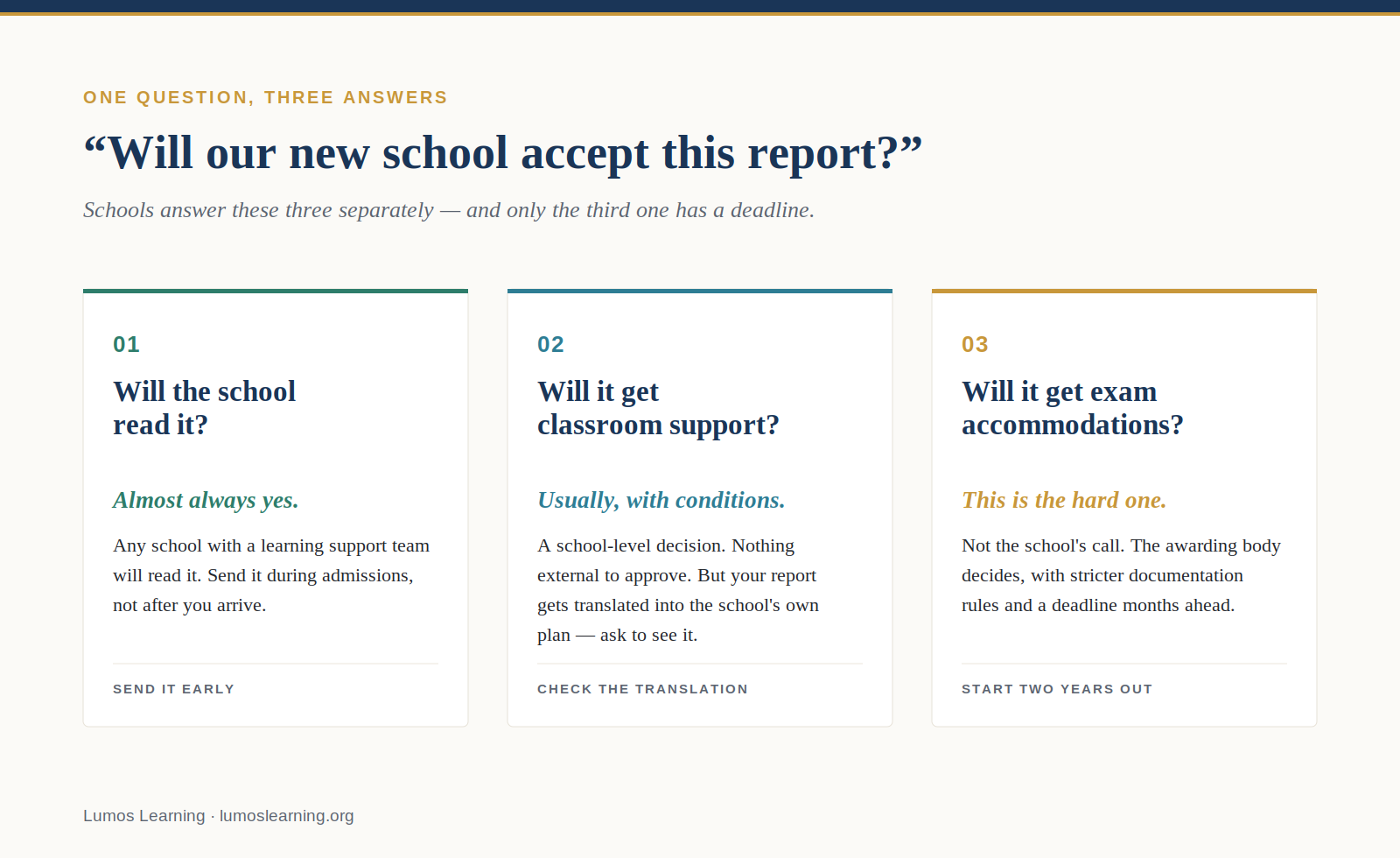
The three questions hiding inside one question
1. Will the school read the report?
Almost always, yes. Any international school with a functioning learning support department will read a report you provide, and most want it before your child's first day. Send it during admissions, not after arrival.
One caution that surprises parents: sharing the report is usually voluntary, and some families hold it back, worrying it will affect the admissions decision. It sometimes does — schools vary enormously in how much support they can offer, and a few will decline a place they cannot staff. But withholding it tends to produce a worse outcome: your child starts in September with no supports, struggles for a term, and the school builds its first impression around a version of your child that isn't accurate. I would send it, and I would ask directly what the school can and cannot provide.
2. Will it get classroom support?
Usually, with conditions. Classroom support — extra time on in-class assessments, a reader, chunked assignments, a seat near the front, access to typed work — is a school-level decision. No external body has to approve it. The learning support team reads your report, decides what is practical in their setting, and writes some form of internal plan.
Where this goes wrong is not acceptance but translation. A report written for a US school district speaks in the vocabulary of IEPs and eligibility categories that a school in Bangkok or Singapore does not use. A UK report references JCQ arrangements. A school running the IB will convert both into its own internal document, and things get lost in the conversion. Ask to see the plan the school actually writes, and check it against the recommendations section of your report yourself.
3. Will it get formal examination accommodations?
This is where reports fail, and where the timeline hurts most.
Access arrangements for external examinations — the IB Diploma, IGCSE and A Levels, AP exams, the SAT — are not granted by your school. Your school applies on your child's behalf to the awarding body, which sets its own requirements for documentation. Those requirements are stricter than what most classroom teams need, and they are the reason a perfectly good report can be turned down.
For example, a student arrives in Grade 10 with a report from her previous country. It is thorough, it is only two years old, and it names dyslexia clearly. The learning support team reads it, gives her extra time on class tests and access to a laptop, and everything works. Two years later the school submits her request for extra time in the Diploma examinations, and it is declined.
Nothing went wrong with the diagnosis. The report simply said "diagnosed with dyslexia; extra time recommended as needed." It did not report her reading and processing speed as standardized scores, it did not describe how her difficulty affects her under timed conditions, and it did not specify how much additional time. Her classroom team never needed any of that — they could see what she required and act on it. The awarding body could not. It had one document to work from, and that document made a claim without evidence behind it.
If you want to know whether your own report has this problem, open it to the recommendations section and look for three things: standardized scores in the areas the difficulty affects, a description of what happens under timed conditions, and a specific arrangement rather than a general one. "Extra time recommended" is general. "25% additional time in written examinations" is specific. If all three are there, you are in good shape. If they are not, you have found the gap early, which is the whole point of finding it at all.
Why reports get turned down
The report is too old. Most awarding bodies, including the IB, expect supporting evidence from within roughly the last three years at the time of the examination session. A report written when your child was nine will not support a Diploma request at seventeen, no matter how thorough it was.
It names a diagnosis but not an impact. Awarding bodies are not really interested in the label. They want evidence of how the difficulty affects performance under timed conditions, expressed in standardized scores, and a clear statement of what arrangement would address it. "Diagnosed with dyslexia; recommend accommodations as appropriate" will not survive review. A report that documents processing speed and reading fluency scores and then specifies the arrangement will.
The assessor's qualifications don't match the requirement. Different bodies require different professionals — a psychologist, a specialist assessor with a particular practicing certificate, or in some cases a medical doctor. A report from a well-regarded professional in one country may not meet the credential requirement of a body in another.
There is no history of need at the new school. This is the one that catches relocating families hardest. Most awarding bodies expect the arrangement to be the student's normal way of working — already in place in class, already used in school assessments, documented over time. A student who arrives in Grade 11 and requests extra time in Grade 12 examinations, having never used it at that school, is a difficult case to make even with an excellent report.
The deadline passed. Requests generally have to be submitted well ahead of the session — for the IB, typically around six months before the examination sitting. Your coordinator will know the current date. If you arrive after it, you may be waiting a full session.
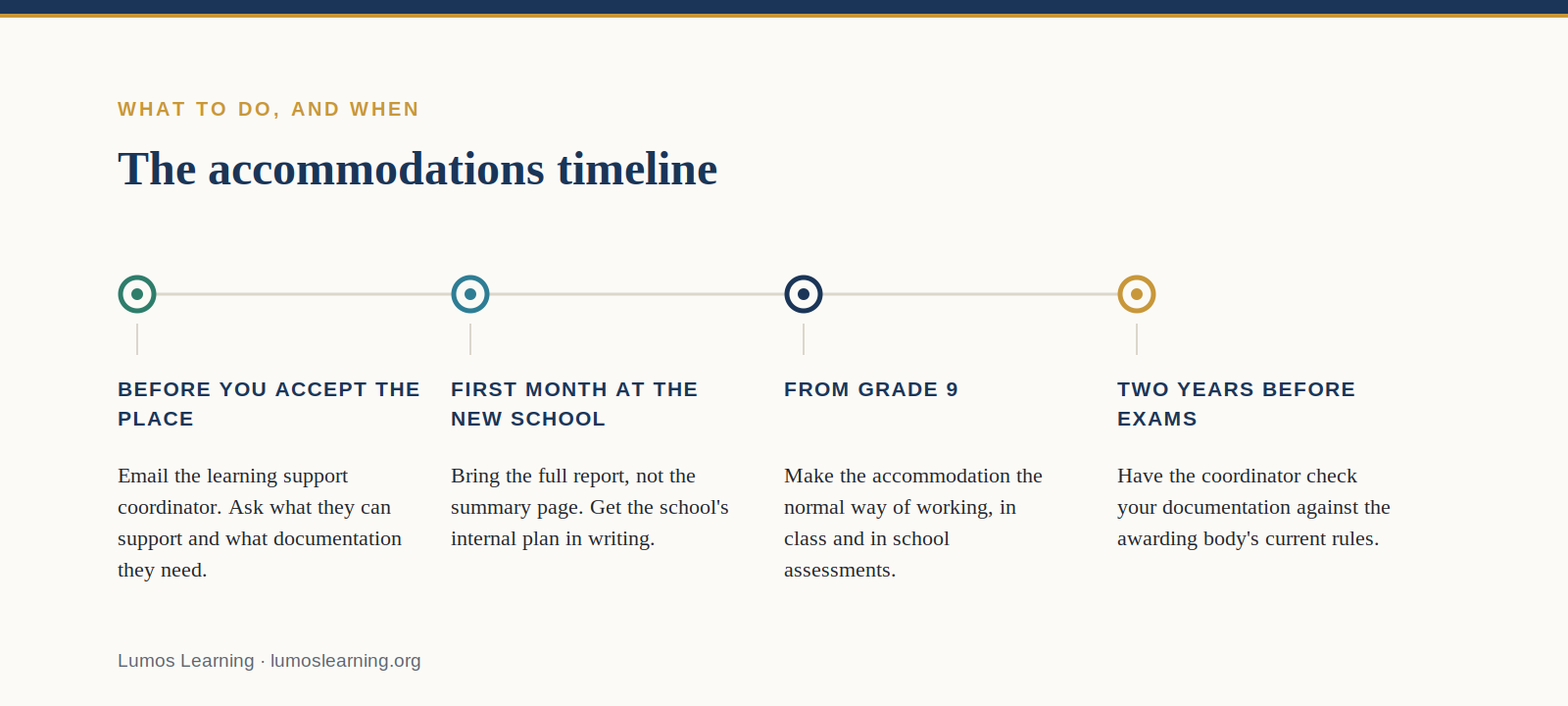
What to do, and when
Before you accept the place. Email admissions and ask to be put in touch with the learning support coordinator. Ask three specific things: whether they can support your child's profile, whether they accept external reports for internal planning, and what documentation the school needs for external examination arrangements. A school that answers these clearly is telling you something useful about how it operates.
In the first month. Book a meeting, bring the full report rather than the summary page, and ask which recommendations are already in place and which need a decision. Ask who owns each one. Get the school's internal plan in writing.
As soon as external examinations are on the horizon — realistically, from Grade 9 — ask the coordinator to review your documentation against the awarding body's current requirements. Do this early enough that a gap can be fixed. Two years out is comfortable. Six months out is not.
If your report does not hold up
You may not need to start over. Depending on what is missing, the options run from cheapest to most involved:
A letter of clarification from the original assessor, restating findings in the format the awarding body wants.
A partial update — retesting the specific areas the body requires current scores for, rather than the full battery. Faster and considerably less expensive than a new evaluation.
A full reassessment, which is genuinely warranted when the report is over three years old, when the profile has changed, or when the original assessment did not account for your child's language background.
That last point deserves its own note. If your child was assessed in a language that was not their strongest at the time, or in a country whose norms do not fit their schooling history, the verbal scores in that report may understate them significantly. That is worth reviewing on its own merits, separate from any examination question.
You have already done the hard part.
You got your child assessed, and you understood what came back. What is left is smaller: making sure the right people at the new school have actually read it, and that someone has checked it against the rules your child will eventually be examined under. That check takes one email now, and it is the difference between a folder that follows your child around and one that actually works for them. Send it this week, and the next move will be the easiest one you have made.